


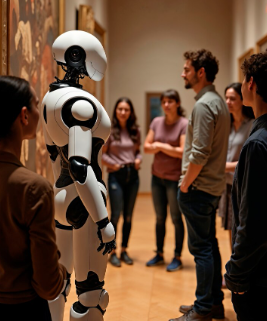
As artificial intelligence and robotics reshape industries, organizations are facing a profound transformation that goes far beyond technology. This new era calls for a redefinition of leadership and organizational development—one that places human potential, adaptability, and strategic vision at the center.
Rethinking Leadership in a Technological Era
Traditional leadership models, often based on control and predictability, are no longer sufficient in environments characterized by uncertainty and rapid change. In the age of AI and robotics, leaders must evolve into facilitators of transformation, capable of navigating complexity while fostering trust and engagement.
This new form of leadership requires a balance between technological understanding and human sensitivity. Leaders must be able to interpret data-driven insights while remaining attentive to the emotional and cognitive dynamics of their teams.
From Hierarchies to Adaptive Organizations
AI-driven environments demand more agile and flexible organizational structures. Rigid hierarchies are gradually giving way to adaptive systems that encourage collaboration, autonomy, and continuous learning.
Organizational development strategies must therefore focus on creating ecosystems where innovation can emerge organically. This includes promoting cross-functional collaboration, encouraging experimentation, and embedding learning into everyday practices.
The Central Role of Human Skills
While AI and robotics enhance efficiency and automate processes, they also increase the value of uniquely human skills. Critical thinking, creativity, emotional intelligence, and ethical judgment become essential competencies in this new landscape.
Organizations must invest in developing these skills, recognizing that long-term performance depends not only on technological capabilities but also on the quality of human interactions and decision-making.
Augmenting Work, Not Replacing People
A key challenge for organizations is to integrate AI and robotics in a way that augments human work rather than replaces it. This requires a strategic approach to job design, where technology supports employees in higher-value tasks instead of displacing them.
By redefining roles and workflows, organizations can create more meaningful work experiences, enhancing both productivity and employee satisfaction.
Ethical and Responsible Transformation
The deployment of AI and robotics raises important ethical questions, from data governance to the impact on employment and workplace equity. Organizations must adopt responsible frameworks that ensure transparency, fairness, and accountability.
Leadership plays a crucial role in setting these standards and fostering a culture where technological innovation aligns with societal and organizational values.
Building a Learning Organization
In a context of continuous disruption, the ability to learn becomes a strategic advantage. Organizations must evolve into learning systems where knowledge is constantly created, shared, and applied.
This involves investing in training, encouraging curiosity, and leveraging intelligent systems to support personalized professional development. Learning is no longer a phase but a continuous process embedded in the organization’s DNA.
Conclusion
Leadership and organizational development in the age of AI and robotics require more than technological adoption—they demand a profound cultural shift. Organizations that succeed will be those that combine innovation with a strong human-centered vision.
By empowering leaders, developing human capabilities, and integrating technology responsibly, organizations can navigate complexity and build sustainable performance in an increasingly intelligent world.